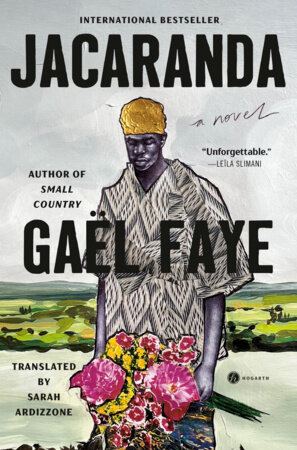

Few novels capture what, we, survivors bury deep within ourselves, or how it shapes the lives of our spouses and children, as closely as Gaël Faye’s Jacaranda. It reaches the place my friend Olivier calls muri kami ka muntu, where even those closest to us struggle to really reach.
Scholastique Mukasonga’s The Barefoot Woman came close for me, but it is a memoir. Jacaranda is a novel, yet it feels so familiar that I kept wondering where fiction ends and lived experience begins.
I read it in French in 2024, as I did Petit pays (Small Country), and couldn’t put either down. Faye is a born storyteller. Now Sarah Ardizzone’s English translation lets many more readers discover him.
Many of you will recognize yourselves somewhere in these pages. There is Milan, growing up in France and trying to understand the family history his Rwandan mother, Venancia, keeps locked in silence. And there is Venancia herself. How do you tell your child what you can barely bear to remember, especially when the people around you show so little interest in understanding?
If you lived through the genocide as a child, as I did, Claude’s story will feel deeply personal: the machete scars, the headaches and nightmares, the need to know what happened to his parents. His courage before his family’s killers at the gacaca trials moved me. I understood his anger, too, and the painful distance between a court’s judgment and the feeling that justice has been done. Orphans raised by relatives may also recognize his sense of betrayal when Venancia, his half-sister, sends him back to Rwanda after treatment in France.
Then there are Eusébie, who speaks of the genocide in public but not at home, and her daughter, Stella, born after 1994. Stella’s attachment to the jacaranda tree in their yard, beneath which her murdered siblings are buried, gives shape to a loss she never witnessed. She reminded me of a colleague, also a child of survivors, who recently told me how painful it is to know so little about what her parents survived. Our children live with what we cannot tell them.
Jacaranda touches on almost every part of life after the genocide, including, I suspect, some things Faye may not have set out to show: the small details you rarely find in academic journals or other books. One caught my eye. In one scene, Milan’s grandmother, a Tutsi who lived as a refugee in Burundi and came home after 1994, says she doesn’t trust Josephine, her housekeeper, or another survivor who works for her. Survivors, she says, are bad people who are jealous of returnees like her.
It is a passing line, but every survivor will recognize it. The tension between those of us who stayed in Rwanda and our fellow Tutsi who fled in 1959 and the years that followed was real, and it remains today. We expected a cold shoulder from Hutu neighbors and from the families of those who killed ours. We did not expect to see the same coldness in the eyes of some returnees from Burundi, Congo and, in my experience, especially Uganda. It was as if we were guilty of surviving. I have written before about how we were left to bury our dead with little help from returnees, and how some RPF leaders from Uganda still call survivors who don’t show allegiance “collaborators” of the old regime. That disdain seems to have cooled a little as we rebuilt our lives and graduated from college, but it has not gone away.
The book also filled me with gratitude: for Sartre, the book lover who shelters street children, the mayibobo, and for the Hutu woman who saved Claude. They made me think of Simeon and his family, who hid my sister and me until the genocide ended. I am glad those brave Hutu stories have a place here, too.
For me, this is one of the finest novels about life after the genocide against the Tutsi. My English copy will soon join my French one on the shelf. Get yours. And if you are near Charleston, South Carolina, you can hear Faye in conversation with Peter Godwin at the Charleston Literary Festival next week, on Tuesday, November 10, at 7 p.m.


Leave a Reply