Mukabose Emertha warokotse wenyine mu kagari ka Ruragwe
Mukabose Emeritha umubyeyi warokotse Jenoside yakorewe Abatutsi agasigara ari incike aratabaza kuko ngo akomeje gukorerwa ihohoterwa. Atuye mu murenge wa Rubengera, Akagali ka Ruragwe, Umudugudu wa Rutaro, muri Karongi.
Umwaka ushize abantu batamenyekanye bamusenyeye inzu none ngo bongeye baroga inka ye yaramaranye imyaka ine ihaka biyiviramo gupfa.
Iyi nka imaze gupfa barayibaze mu gifu cyayo basangamo imifuka y’amagunira, impu z’inyamaswa, n’imisatsi y’imikorano y’abagore (mèches).
Mukabose avuga ko inka ye yarozwe n’abaturanyi be kuko n’ubusanzwe bahora bamubanira nabi ngo kuko ariwe wacitse ku icumu rya Jenoside wenyine utuye mu mudugudu wa Rutabo.
Ati: “Barantoteza none n’inka nahawe na FARG barayihitanye! Si ibya none kuko n’ umwaka ushize bansenyeye inzu ntakambira ubuyobozi bw’umurenge ndongera ndubakirwa. Bashaka ko ntaba muri uyu mudugudu abayobozi bari bakwiye kumba hafi.”
Mukabose yari atwaye ibyo bakuye mu nda y’inka abijyanye ku murenge wa Rubengera kubyereka ubuyobozi ni na bwo yaganiraga n’Umuseke.
Atunga agatoki kandi umuvuzi w’amatungo ngo kuko yamusabye kenshi ko inka ye yavurwa hanyuma aho kugira ngo abe ariwe wiyizira ahubwo akohereza uwimenyereza umwuga na we utaragize icyo abikoraho.
Ngo inka ye yarinze ipfa uwo ‘muganga’ wimenyerezaga umwuga ayireba. Uyu wimenyereza umwuga ngo yabwiye ny’iri nka ko n’iyo na muganga mukuru w’amatungo aza na we ntacyo yari bubashe guhindura ku buzima bwayo kuko ngo atari buvure ‘amarozi’.
Uyu mubyeyi afite impungenge z’uko nyuma yo gusenyerwa inzu, none bakaba bishe inka ye, ngo ni we bazakurikizaho.
Umuyobozi w’umurenge wa Rubengera Ngendambizi Gideon yavuze ko icyo kibazo atari akizi bityo ngo agiye gukurikirana nasanga Mukabose atotezwa koko, azabyikurikiranira ashyikirize ubugenzacyaha abazaba bakekwaho uruhare muri ibi bikorwa.
Isesengura ryacu (Al.G)
Biramenyerewe ko abarokotse jenoside by’umwihariko batuye mu byaro bahohoterwa mu buryo bunyuranye bamwe bakanicwa. Umwaka ushize wonyine umuryango IBUKA washyikirije Sena y’ u Rwanda urutonde rwa dosiye zisaga 50 zigaragaramo ibikorwa by’ingengabitekerezo n’ihohoterwa rikorerwa abacitse ku icumu. Abacitse ku icumu benshi bahitamo kwimuka burundu aho bari batuye mbere ya Jenoside abandi bakahagurisha kubera ikibazo cy’umutekano. Abandi bacitse ku icumu cyane cyane mu burengerazuba bw’u Rwanda n’amajyaruguru aho abarokotse ari mbarwa mu mirenge bashyirwaho amananiza atuma bimuka burundu. Abaturanyi biganjemo abakoze jenoside bagandisha abandi bakababuza guhingira uwarokotse jenoside kabone n’ubwo yaba yishyura amafaranga menshi. Abanditsi bavuga ko abagera kuri 85% y’abatutsi bari mugihugu batembwe mu gihe cya Jenoside yakorewe abatutsi. Umuryango AERG wagiye ugaragaza ko Amasambu y’imiryango yazimye n’ amasambu y’abana b’impfubyi bari bato mu gihe cya jenoside hamwe na hamwe yatwawe n’abakoze jenoside andi atwarwa na Leta muri gahunda yiswe ”isaranganya”. N’ubwo hari intambwe yatewe mu bijyanye n’ubumwe n’ubwiyunge biragaragara ko inzira ikiri ndende. End
In a country with no tradition of institutional care for the elderly, Rwanda’s widows and survivors of the 1994 mass killings seek dignity at the end of their lives.
SAVE, Rwanda — In the remote hillside village of Save in eucalyptus-covered southern Rwanda, Emmaculate Niwemfite sits on a straw mat near the entry to her two-room apartment. Her door stands ajar, halving the room with a beam of light. She sits in the shadows.
Niwemfite lives by herself, surrounded by stark walls taped with photos of Christian iconography. It’s been 20 years since her husband, children and entire family were killed in the genocide. Afterwards, unable to live in proximity to their killers, she moved into this village. “I’m just alone,” she now laments.
Niwemfite is 65, suffers from asthma, and is unable to walk much due to problems with her legs sustained in a bad beating during the war. She says she spends two weeks a month in a hospital. She has no family left, so the daughters of her friends come to help with household chores and she earns an income from renting another home she owns. But she fears solitude as she ages.
“Imagine I die in my bed,” she says. “No one will know.”
In a culture with no tradition of institutional elder care, Rwanda’s large families have watched over their aging parents since time immemorial. But during the genocide, at least 800,000 Rwandans were killed—300,000 of them children. As many as one-sixth of the genocide survivors were widowed. Today a Rwandan woman can expect to live until 65, but many of these women, who’ve spent years displaying unimaginable self-sufficiency, have been left without children to care for them as they grow old.
Nina Strochlic/The Daily Beast
Niwemfite is a member of a widows collective called Duhozanye, a group that assembled after the genocide to reconstruct a decimated society. They began by building themselves houses and planting seeds in their fields. Two decades later, the organization’s leaders have focused their efforts on constructing a senior care center to assist women like Niwemfite, aging genocide survivors whose families were wiped out in the genocide, leaving no children, or just one, to care for them in old age.
The effort is led by Daphrose Mukarutamu, a statuesque figure in a red embroidered dress and short, sweeping hairdo. Mukarutamu is the founder and president of Duhozanye—which means, “Let us console one another”—and as she moves through the villages where Duhozanye’s members are spread, her formidable presence draws a trail of chattery women.
Mukarutamu clutches both hands to her heart when asked about those early days during and after the killing. She had left on a 2.5-hour trip for the capital of Kigali the night before war broke out. It was the last time she’d see her family. When she returned, a neighbor told her that her husband and eight of her 11 children had been killed.
“Imagine I die in my bed. No one will know.”
“At that time we thought that even death doesn’t like us,” Mukarutamu says of the survivors.
Barely five months later, Mukarutamu gathered fellow widows to start Duhozanye.
Some 330 of them attended that first meeting and became the group’s founders. For the first two gatherings they wept together. At the third, they stopped crying and started rebuilding. They broke off into groups of a dozen and got to work collecting bricks and salvageable materials from the rubble. From donated seeds, they slowly built back the agriculture they once lived off, and later incorporated sewing and craft cooperatives. “We were living schools,” she remembers.
Today, Duhozanye has 3,000 members scattered over the southern district of Gisagara, organized into small local chapters of two or three dozen women and a central body of leaders from the various villages.
But now, at 67, Mukarutamu worries about herself and her fellow widows. After two decades of hardship and self-sufficiency, another factor beyond their control is creeping up on Duhozanye’s leadership: old age. The organization’s founding members range from late 50s to early 90s. “We’re getting old and will be beneficiaries instead of partners,” she says.
Nina Strochlic/The Daily Beast
Outside the organization’s headquarters, a couple dozen young adults are lounging on the lawn. These are orphans that were taken in by the organization 20 years ago. The majority are now in school elsewhere but return each year during commemoration. After the genocide, more than a hundred orphans were collected and cared for by the women, many of whom had lost most, if not all, of their own children.
Mukarutamu quotes a Rwandan adage about an old, slow rabbit being fed by its children, and then posites the question: “But what if it has none?”
Down the street, Langwida Kanyange sits on the floor of her friend Emmaculate Niwemfite’s small home. She’s younger than the others at 48, but her skin hugs a face so gaunt she looks much older. Kanyange has AIDS, a byproduct of a gang rape she suffered during the genocide. After the bloodshed in Rwanda, an estimated 70 percent of the 200,000 women raped were infected with HIV. Her son was also a result of the attack; he’s now a 20-year-old student finishing secondary school.
She too spends the days at home alone, weakened by the medication she takes. It’s freely provided by the government, but she has trouble getting special food that doesn’t make her ill. “When I don’t have enough to eat it reminds me of the genocide,” she says.
If the members of Duhozanye realize their goal to build a senior center, Kanyange, and Niwemfite would be the first to reap its rewards.
“I will immediately agree because I will be with others—I’d agree the same day, then the group looking after me would be free to do whatever they want,” Niwemfite says.
The center Mukarutamu imagines will provide a safe environment for the elderly, and offer hospice care for those at the end of their days or survivors from the hard-to-reach areas in need of constant medical attention. She foresees a project manager, nurses, social workers, and guards, along with an on-call doctor and legal advisor. Another widows cooperative, Avega, is also currently attempting to open a retirement home for widows of the genocide.
“It’s a moral obligation to take care of elderly people in our society, but now these elderly people are expecting to be taken care of by children, and their children are no longer there because they were killed in genocide,” says Claire Umubyeyi, a Rwandan survivor and 17-year veteran employee of the United Nations. “You’re denied this security of aging in dignity because you don’t have family to take care of you.”
After a generation wiped out by genocide, an age gap has left the country’s elderly population overly reliant on its small labor force. In Rwanda, an unbalanced ratio leaves 83 of every 100 citizens dependent on the leftover 17 for survival.
In Save, the single road running through town is quieter than usual, as most of the residents have gathered at an outdoor genocide remembrance meeting, held in every Rwandan village for a few hours per day during the national week of mourning in April. During these gatherings, survivors and perpetrators alike share their stories—many horrendous—to preserve the national memory and educate future generations.
Even though it was only two decades ago, most of Rwanda’s citizens don’t remember the time of war—61 percent of the population is under the age of 24. But memories of the killing don’t come to light only in yearly national ceremonies. On the drive into the single-road village, a mass grave is said to hold the remains of 3,000 people. Just before commemoration week, the province had uncovered another body and was preparing it for burial.
It will also offer a program for survivors to relay their memories into shards of history as part of a belated healing process many were never offered. “When those people die its like a library is gone,” Umubyeyi says. She was particularly upset when an 84-year-old woman named Mary whom she had grown fond of passed away last year in her rural home with no one there. “We could have benefited off her wisdom.” This center, Umubyeyi says, will “make sure these survivors who have suffered so much get some sort of care and die in peace.”
Duhozanye has the land and the need, but lacks the $300,000 it will cost to build and sustain. In the hopes of raising the money, the organization is writing up grant proposals to send across the world. In January, Umubyeyi and Mukarutamu hope to bring a group of volunteers and potential investors to see Duhozanye’s headquarters and meet its members.
In a dim backroom of a mud hut in Save, 82-year-old Teresa Nyirabutunda sits propped upright in bed by her daughter, Francine. Francine says caring for her mother, who can’t process solid food or move by herself, is similar to having a baby. She was the only survivor of the genocide among her siblings and now worries about caring for both her mother and herself because she, too, is aging. “I live by miracles you can’t believe,” she says.
But even for children struggling to care for elderly parents on their own want to abide by tradition. Francine is adamant that her frail mother stays in her house—“She is my mom. Even if she’s very sick I will look after her until she dies. I wouldn’t let them take her,” she says of having her mother live in the center. She admits, though, that she could desperately use the health care services.
In a country where an almost paradisical landscape somehow hosted the fastest genocide of the 20th century, hurdling such seemingly unconquerable challenges is now woven into the national identity, and Duhozanye’s leaders are confident that battle-worn women like Teresa will have their hardships alleviated before the end.
“Rwanda is country of thousand hills, a thousand problems, and a thousand solutions,” Umubyeyi says
As the world commemorates the 20th anniversary of the genocide against the Tutsi in Rwanda, renewed efforts supporting survivors to realize their right to reparation are gaining traction. Following a call from victim organisations in Rwanda for increased attention to the lack of a comprehensive reparation effort for victims of the genocide, the International Criminal Tribunal for Rwanda (ICTR) in Decem-ber 2013 mandated the International Organisation for Migration (IOM) to conduct a study on the state of reparation for victims in post-genocide Rwanda.
In light of similar studies the IOM has carried out in, for instance, Sierra Leone, Colombia, and the former Yugoslavia, the IOM is expected to provide technical input to stakeholders on the tangible ways forward for reparation for genocide victims, including the identification of feasible and suitable mechanisms for implementing and funding a comprehensive effort. To this end, the IOM will carry out broad consultations throughout the country with survivors and survivor organizations, as well as government representatives and relevant international and regional actors.
In late February 2014, IOM carried out its first consultation visit in Rwanda, resulting in a collaboration with the government of Rwanda, as well as the main survivor organizations. This is sending important signals of hope for survivors: for the first time since the genocide the government of Rwanda – through the Minister of Justice and Attorney General of Rwanda- publicly recognized that survivors of the genocide have a right to reparation.
The Minister of Justice expressed the government’s commitment to support initiatives addressing the right to reparation. In addition to the IOM study, the government announced the establishment of a new national forum for discussion on reparation within the Ministry of Justice to serve as a joint think-tank on how best to realize the right to reparation.
These developments are long overdue. For the past twenty years, survivors and survivor organizations have continuously called on the government of Rwanda as well as the international community to provide adequate reparation to survivors. However, their calls remained mostly unheard, instead, the emphasis was placed on the prosecution of the perpetrators before traditional ‘Gacaca’ (community) courts and the ICTR. The majority, if not all of these prosecutions, relied heavily on survivors’ testimonies.
For many of those who testified in proceedings before Gacaca and the ICTR, their testimony came at a high price: survivors have been ostracized from their communities and continue to fear reprisals as a result of their testimonies. Women who were raped and who came forward with their testimonies frequently complain about being stigmatized and humiliated by their rapists.
The closure of Gacaca courts in July 2012 and the winding down of the ICTR left survivors disillusioned by the justice processes they have done so much to support. Failure by national and international processes to provide reparation for victims and survivors with reparation has left a sense of unfinished business.
For genocide survivors, reparation is the most tangible manifestation of the state and the international community’s efforts in acknowledging and repairing their lives. The IOM
study, carried out on in collaboration with the Government of Rwanda and civil society, is an encouraging step in the right direction.
It is expected that the IOM’s final report will outline the roadmap for the way forward and include recommendations for all actors involved including the government of Rwanda and the international community.
The real test, however, will be whether there will be the necessary political will to implement the recommendations in practice and provide adequate reparation to survivors.
First appeared in Pan-African Reparation Perspectives | July 2014 | Issue 2 page 4
Twenty years later, a new momentum to provide reparation for genocide victims in Rwanda
By Albert Gasake,
Jenoside yakorewe Abatutsi mu 1994 yabaye Nyiransengimana Cristine afite imyaka itanu, avuka kuri ba nyakwigendera Kagabo Patrick na Mukandinda Speciose, yavukiye ahitwaga komine Mwendo (mu Birambo) hari muri Perefegitura ya Kibuye, ubu aba mu mujyi wa Korongi, ntarabona inzu yuzuye yo kubamo, agerageza kwirwanaho ngo abeho.
Uyu mukobwa utihanganira ibyamubayeho (rimwe na rimwe mu kiganiro n’umunyamakuru imvamutima zamurushaga intege akarira), yavukanaga n’abana batanu na we wa gatandatu. Se umubyara Kagabo ngo yari umukirisitu Gatolika uzwi na benshi aho yari atuye. Bose barishwe.
Jenoside itangiye, Kagabo yanze guhunga, Interahamwe ziramwica na ho umugore we Mukandinda yatemwe n’Interahamwe zimujugunya mu musarani, akirimo umwuka, ahamara iminsi bamuvanamo ariko nyuma aza gupfira kwa muganga, ni ibyo Christine yabwiwe. Yibuka ariko ko yabonye nyina bamutema ariko ntashiremo umwuka.
Christine Nyiransengimana yaje gusigara wenyine bitewe n’uko yanganaga muri Jenoside avuga ko hari byinshi atibuka kuko ngo abaturanyi ni bo bamubwira ibyabaye. Abavandimwe bo bose bagiye bamubwira uko bishwe bose bagashira.
We yarokotse ku buryo atazi neza gusa yibuka ko babagaho bihishahisha, ndetse avuga ko afite igisare cyo kutumva neza yatewe n’ibuye rinini ryamwituyeho bihishe mu mukoki mu gihe bahigwaga muri Jenoside.
Yaje kujyanwa mu kigo cy’imfubyi i Shyogwe mu Ntara y’Amajyepfo (Gitarama), nyuma muri 2002 hajyaho gahunda yo gusubiza abana b’imfubyi aho bakomoka, ni ko kujyanwa mu kigo cy’imfubyi i Nyamishaba (Kibuye).
Yarize arangiza amashuri yisumbuye ubwo ibigo by’impfubyi byafungwaga yajyanywe mu murenge w’iwabo wa Gashari kugira ngo ashakishe umuryango wamwakira.
Muri uwo murenge yabuze abantu bamwakira, ubuyobozi bw’Umurenge bumwohereza mu murenge wa Bwishyura (mu mujyi wa Karongi) aho yakuriye, hari muri 2008.
Yakomeje gushyira igitutu ku buyobozi bw’Umurenge wa Bwishyura ngo bumushakire aho aba, ariko bakamubwira ko ikibazo cye kizakemuka, agategereza.
Icyo gihe hari abana b’imfubyi bafite abantu bo muri Amerika babafasha barabashakiye inzu, i Karongi nibo yabanaga nabo ariko nyuma baza kujya muri Amerika abandi bashaka abagabo n’abagore, Nyiransengimana asigara wenyine nanone.
Iyo nzu yari itarashyirwaho inzugi, nta bwiherero nta n’igikoni ifite, gusa umwe muri ba bana bagiye muri Amerika yamwoherereje amafaranga Nyiransengimana ngo agure inzugi ebyiri urw’inyuma mu gikari n’urw’imbere.
Ubuyobozi avuga ko usibye kuba bwaramuhaye inzu nta kindi buramufasha mu kugirango inzu yuzure neza.
Uko abayeho
Hari abandi bana b’imfubyi bari bacumbikiwe mu nzu ya Caritas iri hafi y’Ikiyaga cya Kivu ku ihembe rya Bwishyura. Aha niho abana n’umwana w’umuhungu na we w’imfubyi kuko abandi bagiye kwiga.
Afite impungenge nyinshi z’aho azerekeza kuko iyi nzu babwiwe na Caritas ko bayikeneye, mu gihe iye atayijyamo itaruzura neza.
Yari afite abavandimwe bane nawe wa gatanu n’ababyeyi, Jenoside itangira iwabo i Gishamvu aho bari batuye yari umusore w’imyaka 28, mu gihe bahungaga we yanze guhungana n’ababyeyi b’abavandimwe ahubwo ahunga yerekeza i Burundi, mu nzira yaratemaguwe bikomeye ajugunyw amu Kanyaru ariko aza kurokoka, atashye mu Rwanda yasanze abe bose barashiriye muri Kiliziya ya Nyumba. Ku myaka 48 ubu aherutse kugarura ikizere cyo kubaho mu myaka itatu ishize.
Siboniyo Athanase Jenoside yamusigiye ubumuga bukomeye, ku mubiri no ku mutima, iwabo bari batuye muri Komini Gishamvu muri Butare, yibuka ko mbere gato ya Jenoside hari Abahutu ngo bajyaga batera ingo z’Abatutsi ariko abaturanyi babo b’Abahutu bagatabara.Ati “Imiryango yacu yose yari ibanye neza, nta washoboraga kwica abaturanyi be.”
Siboniyo yibuka ko ubwicanyi bwatangiye i Gishamvu mu mpera z’ukwezi kwa kane cyangwa mu ntangiriro z’ukwa gatanu ubwo uwari Perezida Theodore Sindikibwabo yazaga i Gishamvu mu ijambo rye agasaba Abahutu “Gukora”.
Ati “Icyo gihe abantu batangiye guhinduka, batangira kwica abantu, maze imiryango myinshi ihunga yerekeza kuri Kiliziya ya Nyumba kuko bari baziko nta muntu wica uwahungiye mu Kiliziya.”
Nyuma yo kutabyumvikanaho neza n’umuryango we aho bahungira, Siboniyo avuga ko we na mubyara we berekeje inzira igana i Burundi ntibajyana n’umuryango we i Nyumba mu Kiliziya aho bari baturiye.
Urugendo rugana i Burundi rwari rukomeye, yaratemaguwe kugenda kugera ku Kanyaru (umugezi utandukanye u Rwanda n’u Burundi).
Yegeze ku Kanyaru ajugunywa mu mazi ariko yari agihumeka, intwaramuheto (ingabo) z’i Burundi nizo zamuvanye mu mazi zimujyana aho avurirwa arokoka atyo.
Ubuzima bukomeje kumugora cyane i Gishamvu mu 1996 yerekeje i Kigali, mu by’ukuri nta muntu ahasanze nta n’akazi agiye kuhakora, kujya i Kigali byari nko guhunga nanone, ubuzima bubi cyane i Kigali ntabwo bwatumye abasha kuhaguma.
Ntacyo yagezeho mu myaka irenga 10 yamaze i Kigali, aza gufata umwanzuro agaruka ku ivuko akomeza gushakisha uko abaho mu mu cyaro mu miryango.
Mu myaka itatu ishize, Siboniyo yubakiwe inzu ndetse ahabwa inka muri gahunda ya Girinka. Ati “Nibwo ikizere cyo kubaho natangiye kukigira, nyuma y’iyo myaka yose mu buzima bukomeye cyane.”
Photo SURF/David Russell, in middle.In the UK, at a meeting at London’s King’s College, David Russell of the UK charity SURF (Survivors Fund) launched an appeal to the international community to support reparations for survivors of the genocide.
He described how more than 300,000 survivors still face severe trauma, HIV infection through rape, and loss of land and property.
The UN General Assembly has passed resolutions calling for UN agencies to provide help, “yet such calls have largely gone unheeded,” he said.
“In fact, there is no framework for reparative justice for survivors of the genocide, either in Rwanda or internationally,” he pointed out.
According to one report, Russell compared UN aid for survivors’ in Rwanda of less than $1 million with the $1 billion spent by the UN International Criminal Tribunal for Rwanda (ICTR) – more than $30 million per conviction.
SURF and seven survivor-led organisations in Rwanda focus on reparations and the establishment of an International Trust Fund to support survivors. An International Organization of Migration report on its feasibility, commissioned by the ICTR, is expected this year.
“The 20th anniversary of the genocide and the closure of the ICTR … is a unique opportunity to address the issue of reparation and call for an explicit form of reparative justice for survivors to be prioritised through funding from agencies, funds and programmes of the United Nations, or through voluntary contributions from Governments and the international community,” says Russell.
The Genocide in Rwanda began in April 1994 and was executed by the ethnic Hutu majority.
Then U.S. President Bill Clinton, who is a close ally of Rwandan President Paul Kagame and then-UN Secretary General, Kofi Annan, have in the past issued apologies for failing to stop it.
In the lead up to the main events on April 7 in Kigali, a symbolic fire traversed the country and lit up several flames to mark the Kwibuka ceremony of remembrance. It happens every year to commemorate the genocide and citizens to personally reflect on its horror, examine its causes, and hopefully, say “never again”. But as it is marked for the 20th time, the out-pouring of support has been remarkable. End
Uwacitse ku icumu rya jenoside yakorewe abatutsi, Rutsindura Gratien, w’imyaka 59 wari utuye mu murenge wa Kabwayi akarere ka ruhango ku mugoroba wo ku itariki ya 27/02/2014 yakubitswe n’itsinda rigizwe n’abo mu muryango yashinje gukora jenoside mu gihe cy’inkiko Gacaca bimuviramo urupfu.
Umuyobozi wa IBUKA mu karere ka Ruhango Bwana Joseph Twagirimana yavuze ko ibyabaye kuri Rutsindura bibabaje kandi ko n’abacitse ku icumu basigaye ejo n’ejo bundi byababaho. Yagize ati’’ Rutsindura yari umwe mubanyamuryango bacu. Ibyamubayeho natwe ejo byatubaho. Ndasaba inzego z’umutekano kongera imbaraga mu gukurikirana abagize uruhare mu rupfu rwa Rutsindura’’
Dieudonee Byukusenge umwana wa nyakwigendera ubusanzwe ukora umurimo w’ubu Agronome avuga ko ubwo yari avuye mu mu gishanga aho akorera yabonye ikivunge cy’abantu bari hagati ya 15-20 bashungereye mu gihe hari undi muntu wari gutaka abamukubita bavuga ngo ‘’ yumve kuko nawe yafungishije benshi muri gereza’’.
Byukusenge w’imyaka 25 uko yageragezaga kwegera ngo arebe neza ibiri kuba nibwo yamenye uri gukubitwa ari se umubyara. Nawe ubwe batangiye kumukurura amashati badashaka ko akomeza kwinjira hagati mu kivunge aho se yari. Byukusenge avuga ko se yakubitswe imigeri mu mbavu igipande kigana ku mpyiko, ndetse ko yasanze se atavuga yubitse inda kugirango badakomeza kumukubita munda. Nyakwigendera yaba yarakubitswe kandi ku mutwe w’inyuma no ku mitsi yo ku irugu. Urwo rugomo rwabaye ubwo yari agiye kwishyuza ubwatsi bw’inka ze.
Komanda wa polisi station ya Kabwayi twavugishije kuri telephone wirinze kudutangariza amazina ye, yavuze ko ibyu urupfu rwa Rutsindura babimenye mu gihe cyo gushyingura ku wa kabiri w’iki cyumweru. Yongeyeho ko bo bakurikirana iyo hari umuntu watanze ikirego. Yavuze ko gupima umurambo bimenyerewe ku izina rya Autopsie byaba bitarabayeho. ngo yatangiye gukurikirana iki kirego ejo ku wa 13/03/2014 nyuma y’uko abo mu muryango wa bagejeje ikirego kuri polisi. Abo mumuryango wa nyakwigendera bo bavuga ko bamenyekanishije ikibazo kikimara kuba.
Abakubitaga nyakwigendera ni abo mu muryango w’uwitwa Maritini bari baje mu bukwe bavuye I Kigali. Martini uwo yahamwe ni’cyaha cya jenoside aranafungwa. Abakubise nyakwigendera ngo baba barabikoze mu rwego rwo kwihorera. Nyakwigendera ngo yaba yari mu batangabuhamya bashinja mu rubanza rwa Maritini wakoze jenoside. Abakubitaga nyakwigendera nyuma yo kubona umuhungu we ahageze atangiye no guhamagara ubuyobozi bahise binjira mu modoka Minibus RAA 385D yari yabazanye bakuramo akabo karenge.
Igihe nyakwigendera yakubitwaga abo mu nzego zibanze ngo baba barabimenye ariko ntibabyiteho kubera amasano ngo baba bafite n’abakoraga urwo rugomo.
Nyuma yo gutabaza bamwe mu baturage baba barageraje gutangira imodoka ariko biba ibyubusa kuko ngo abari mu modoka bahaye amafaranga abaturage benshi basanze ku gasantere bityo barabareka barakomeza. Byukusenge umwana w’umuhungu wa nyakwigendera yahise ahamagara Komanda wa Polisi sitasiyo ya Kabagari amusaba guhagarika imodoka no guta muri yombi bamwe mu bari bayirimo. Komanda avuga ko agiye guhamagara polisi ya Byimana ngo ihagarike iyo modoka mbere yuko igera I Kigali. Icyokora ngo byaba byararangiriye aho kuko ntacyo komanda wa polisi ngo yakoze. Ibyo icyokora komanda wa polisi arabihakana avuga ko atariwe wahamagawe.
Muri uwo mugoroba nyuma yo gukubitwa, Rutsindura yacumbitse mu rugo rw’umuturanyi bucya bamujyana ku kigo nderabuzima cya Gafunzo nacyo kimwohereza ku bitaro bikuru bya Gitwe. Icyo gihe yari yatangiye kujya yihagarika akanituma amaraso. Abaganga bo kukigo nderabuzima banditse ku mpampuro zimwohereza ku bitaro byisumbuye ko yakubitswe. Agezwa ku bitaro bya Gitwe Rutsindura ngo yari yamaze kujya muri comma. Ibitaro bikuru bya gitwe nabyo byahise bifata icyemezo cyo kumwohereza mu bitaro bikuru bya kaminuza I Butare (CHUB) ku wa gatandatu taliki ya 01/03/2014 ari naho yaje kugwa ku ku itariki 09/03/2014. Nubwo yari arembye ari muri coma, yegejejwe I Butare banga kumuvura, hashira iminsi itatu (3) ataravurwa kuko abamuzanye batibutse ikarita ye ya mituelle de santé.
Cyriaque, mukuru wa Nyakwigendera yasabye ko barenganurwa abagize uruhare murupfu rwa Murumuna we bagafatwa. Cyriaque avuga ko Kwica murumuna we byari mu mugambi mugari wo kumwikiza kuko ariwe mugabo wenyine wari uhari ubabangamiye. Yavuze ko ubwo yajyaga aho nyakwigendera yari atuye yasanze bamwe mu baturanyi batangiye kwigabiza ibye, batema ibiti mu ishyamba rya nyakwigendera banatema ubwatsi bwe. Cyriaque avuga ko icyaba cyateye urupfu rwa Nyakwigendera ari uko yatanze ubuhamya mu nkiko Gacaca ashinja abakoze jenoside. Yongeraho ko hari abantu bagombaga kwishyura nyakwigendera baba nabo babifitemo uruhare. Cyriaque yagize ati’’ Nta mu tekano dufite’’.
Mu gihe cyo gushyingura hari amakuru yamenyekanye ko abakoreye urugomo nyakwigendera baba baraje kureba neza ko koko yapfuye. Muri abo harimo abakatiwe na Gacaca gukora imirimo nsimburangifungo TIG icyokora bakaba batarakoze icyo gihano.
Umwe mu bana ba nyakwigendera yagize ati’’ Turasaba ko Twafashwa abadukoreye uru rugomo bagakurikiranwa bagahanwa. Papa ntiyajyaga arwaragurika. tumubajije niba yumva afite umutekano yadusubije muri aya magambo: Umutekano ntuhagije. Biradusaba kwibombarika tukajya dutaha kare. Turiho tutariho. Ejo ntituzi uko bizamera. Tubishoboye tuzimuka tujye gutura ahandi batatuzi. ‘’
A house build by FARG for a survivor in Gakenke district Photo/AERG
The Rwandan Auditor general identified numerous irregularities in the management and delivery of the Government Assistance Fund for survivors (FARG) programs. The current audit of FARG identified errors in the database and various cases of ghost beneficiaries – where a number of beneficiaries could not be traced to the FARG database of eligible beneficiaries.
The report also revealed poor coordination and potential mismanagement of several billions of Rwanda francs earmarked for education and construction of houses for needy survivors. FARG activities such as management of education funds for secondary school beneficiaries and shelters are managed at the district level. However, many districts did not submit financial and activity reports to facilitate the timely monitoring of their programs. The audit of FARG noted that only 7 districts out of 30 districts submitted reports on the construction of houses for the beneficiaries. A sum amounting to 7 billion Rwandan Francs was disbursed between June 30, 2010 and June 30, 2012 for construction of 3,489 shelters for vulnerable genocide survivors identified as homeless in 2010. The biggest portion of the fund remains unaccounted for.
This is not the first time that funds allocated specifically for sheltering survivors have been mismanaged. In 2011, the Auditor General reported that funds utilized by FARG for the construction of a survivor shelter was “not worth the amount of money spent“. Between 2006-2008 alone, 6 billion Rwandan Francs was transferred by FARG to local districts for the construction of houses or used for the purchase of construction materials. According to the Auditor General “a total of 1,090 eligible individuals selected to receive construction materials did not get them in only five districts surveyed, yet 835 others who were not previously on the approved list obtained the materials.” He also reported that as of September 2010, a stock of 37 tons of roofing nails worth 31 million Rwandan francs was still in the Local Government Ministry’s stores and that some of the beneficiaries who received iron sheets were yet to receive nails.
In addition, the Auditor General highlights concerns over the quality of livestock distributed to the survivors through FARG income generation program. The audit warns that a notable number of cows distributed by FARG especially imported breeds have since died. Many beneficiaries who received the cows did not have the opportunity to utilize their benefits before the cows died. Some imported breeds were not appropriately selected for the Rwandan climate. In other cases, the survivors claimed not to have sufficient financial resources needed to properly feed the animals and provide the necessary and routine veterinary services.
While the auditor general’s report cautions that the identified irregularities may have resulted in the loss of public funds, it does not explicitly indicate the amount of the loss. The 2012 FARG evaluation report discovered that FARG had an under spending of over 50 billion Rwandan Francs since its establishment in 1998. Ibuka called for an immediate enquiry into why this budget has not been utilized – a call that remains unheeded to date. FARG is a 15-year-old fund that assists vulnerable survivors of the genocide against the Tutsi. The Fund has been criticized for its lack of formal representation of survivors in its board of directors. According to survivors organizations, having genocide survivors amongst the members of the board in itself does not address FARG’s shortcomings, as these individuals operate in a personal capacity.
The government of Rwanda has spent over 200 billion Rwandan Francs since FARG’s establishment and yet to many survivors the tangible outcomes and impact remain controversial.
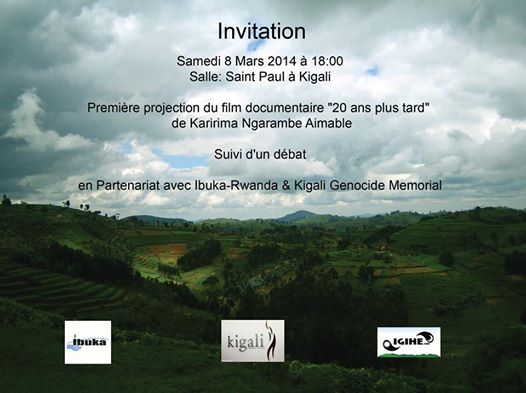
Quand le réalisateur de ce documentaire arrive en Belgique quelque temps après le génocide des Tutsi au Rwanda en 1994, il est meurtri par la tragédie qui vient de se dérouler dans son pays, il a perdu les siens, il a perdu tout espoir. Il se méfie de tout le monde, Belge, Africain, Asiatique, Américain…Toutes ces personnes qui ont laissé faire ça sans réagir…Il en veut à l’humanité entière… Il se pose mille questions, mais comme dit Paul Arden “Toutes les questions ont l’air simple quand on connaît les réponses”. Il va partir à la recherche d’une réponse, une seule: POURQUOI c’est arrivé… ? Sur le chemin du “POURQUOI”, il rencontre des humains de toutes nationalités, toutes races confondues et se rend compte qu’eux aussi sont à la recherche du “POURQUOI”, qu’eux aussi se sont opposés et ont lutté pour empêcher ça, mais rien n’a pu arrêter la folie des hommes…
“Vingt ans plus tard” rend hommage à ces hommes qui ont, à leur manière, eu le courage de lutter pour comprendre. Vingt ans plus tard, ont-ils trouvé une réponse ? Vingt ans plus tard, ils continuent leur quête de l’absolu sans être certains de le trouver, mais avec l’intime conviction qu’accepter qu’il n’y a pas de réponse, c’est accepter que l’humanité n’existe pas …En partenariat avec Ibuka-Rwanda & Kigali genocide Memorial, ce documentaire sera suivi d’un séance questions/réponses en présence du réalisateur Karirima Ngarambe Aimable
Aimable Kalilima/Photo youtube
Entrée libre demain le 08/Mars/2014 Salle saint Paul, Kigali.
Gerorina Nyirandutiye, survivor of the Rwandan genocide, sits on a bench at her house in Nyamigina village, Rwanda. Photograph: Jose Cendon
The severity and pace at which the Rwandan genocide unfolded begs many questions. How does a country begin to recover after such an event? Yet Rwanda serves as a development success story, thanks to the combined efforts of the Rwandan government and wider society.
Nationally, the government created the national commission for unity and reconciliation, in addition to special chambers to prosecute the most notorious war criminals. At the community level, traditional Gacaca courts were employed to provide reconciliation and justice with over 100,000 people indicted for crimes of genocide. Internationally, the United Nations established the International Tribunal for Rwanda (ICTR).
Financial compensation – an essential component of true justice
The government has established a fund, Farg, to provide health care and tuition for survivors. But does this go far enough? Though Rwanda and the international community have valiantly pursued justice, financial compensation for genocide survivors has still not materialised. Can there be genuine reconciliation without financial reparation? The answer, in my opinion, is no. Reparation plays an important role in both mending the damage done and educating society.
This isn’t to suggest that the subject of reparations is not logistically and morally challenging. Damage caused to both people and property must be fairly assessed, and a monetary value assigned to losses. Some would argue that genocide is an irreparable crime due to the sheer scale of psychological and physical suffering.
But irrespective of these challenges, the silence surrounding the subject of financial reparations is striking. In the immediate aftermath of the genocide, Rwanda was a country in ruins. Tens of thousands had been made orphans, widows and refugees. Already scant infrastructure had vanished, and financial compensation was understandably not an initial priority, as attention was fixed upon rebuilding the basics. But 20 years on, dialogue surrounding the issue of financial reparations remains absent from the political discourse.
Why is the political elite hesitating to enforce compensation for victims?
In theory, the Rwandan legal framework explicitly provides for genocide survivors to receive compensation. 50% of judgements made by the specialised chambers for prosecuting genocide suspects have awarded financial compensation to victims. However, although enforced on a criminal level, they have yet to be enforced with regards to financial compensation.
In some cases the Rwandan government itself has been mandated to pay indemnities to the victims. But the minister of justice ordered the suspension of “all cases in which the Rwandan government is called upon to intervene.” In 2001, a bill calling for the creation of a compensation fund was formulated, but it never materialised.
We could interpret this in two ways: either as a demonstration of the practical difficulties of reparations, or as a political decision not to take that route.
It has been speculated that at the forefront of government concerns are how financially compensating the survivors of the Tutsi community may affect social cohesion. Some worry that openly providing government financial support to the Tutsi community could risk fostering resentment amongst the Hutu majority community.
How the international community is failing the victims
It is generally agreed that the UN, instead of protecting civilians, failed them by leaving the country at the peak of the killings. Its reputation among Rwandans has suffered as a result. One would hope that after its failures the UN would take a leading role in compensating survivors. Unfortunately, it has so far shown interest only in criminal proceedings, ignoring financial reparations. Although it did establish the ICTR, it has avoided dealing with the subject of reparations. How can the UN not understand its importance in the rehabilitation of victims and the administration of justice?
It could be concluded that there is a lack of a will to participate in the reparation process. Initiatives have been taken to encourage the UN to amend ICTR’s statute to include the creation of a compensation fund, but without success. According to former prosecutor Carla Del Ponte, “Every judge agrees with the principle that victims should be compensated.”
The UN commission created to compensate Kuwaitis following their 1990 invasion by Iraq – as well as the $1.07bn subsequently made available to the government of Kuwait – shows a willingness to participate in the reparation process. So how can we explain the UN’s reluctance to do so in Rwanda?
Perhaps some of the blame lies with the Rwandan government. Its weak stance regarding financial reparations to the Tutsi people might explain the international community’s hesitance to intervene. The solution to this is concrete measures at a national level to encourage other international partners to participate – a compensation endowment, as was originally intended by the draft law in 2001, for example. We should recognise the contribution of Farg to improving the living conditions of survivors – every year 6% of total state revenue is spent on it. But assisting survivors is an obligation for any responsible nation. It does not remove the right to financial reparations.
About the Writer: Jean Paul Mugiraneza is a peace expert based in Kenya. First appeared in Guardian