For the first time in 30 years, the complete 1991 report of the Rwandan military commission has been made public by Justice Info. Previously, only an extract of this report was known, which the Prosecutor of the International Criminal Tribunal for Rwanda (ICTR) considered foundational evidence of a criminal conspiracy leading to the 1994 genocide against the Tutsi population.
The report was commissioned by President Juvénal Habyarimana amid the civil war waged by the Rwandan Patriotic Front (RPF) since October 1990. Chaired by Colonel Théoneste Bagosora, the commission aimed to advise on defeating the enemy “at a military, media, and political level.” The most controversial part, titled “Definition and Identification of the Enemy,” was used by the ICTR prosecutor to argue that it laid the groundwork for the genocidal plan.
After months of difficulty finding members willing to join its leadership committee, Ibuka-USA, a non-profit organization incorporated in Delaware, announced last week a new team of six dynamic leaders to guide the organization for the next four years. This diverse group brings fresh perspectives but faces challenges, including criticism that they, like other Ibuka chapters, are seen as extensions of the Rwandan ruling party (RPF) and are too closely aligned with the regime. This alignment complicates efforts to advocate effectively for survivors, especially when the regime’s interests conflict with those of the survivors. Can this new leadership overcome these hurdles and drive meaningful change?
At the helm of the new committee is President Marcel Mutsindashyaka, an IT executive at a college in Cleveland, Ohio. Marcel, who has been actively involved in survivor organizations in Rwanda, like AERG and GAERG, is known for his entrepreneurial drive, and as I know him, he doesn’t shy away from engaging in difficult conversations. His leadership style marks a shift from his predecessor and definitely makes him a promising choice for Ibuka-USA.
The rest of the team includes Vice President Favorite Iradukunda, a professor at the Elaine Marieb College of Nursing at the University of Massachusetts Amherst; Mireille Ishimwe, a Doctor of Pharmacy in Indianapolis, who will serve as the Social Affairs officer; Luck Ndunguye from Phoenix, Arizona, as secretary; Nicole Karekezi Umurerwa from Portland, Maine, as a committee member; and Paul Rukema as treasurer.
Ibuka-USA, founded in 2020 as a 501(c)(3) non-profit, aims to support and advocate for the genocide survivors who now live in the United States. The organization aspires to be an umbrella body for other survivor non-profits and individuals in the U.S., similar to its parent organization, Ibuka-Rwanda. This goal is not, however, universally accepted by local survivor groups in the U.S., which have long organized commemoration events and other activities for survivor welfare and genocide education independently.
Globally, there are many Ibuka chapters operating independently from each other, including in Europe, where the first Ibuka was established in 1995 in Brussels, Belgium. These chapters are credited with sustaining the commemoration of the genocide against the Tutsi by organizing annual events, working with host countries to erect memorials, combating genocide denial, and promoting genocide education through conferences and other initiatives.
However, critics argue that Ibuka groups, both in Rwanda and abroad, often align too closely with the Rwandan government, even when this alignment conflicts with the interests of survivors. For instance, Ibuka has been known to support government actions against critics but remains silent when a survivor in their membership is harmed, whether by the regime for dissent or by released genocide perpetrators.
Ibuka chapters abroad are also accused of being influenced by the Rwandan government through its embassies, which exert tight control over these groups. This relationship challenges their independence and hampers their ability to advocate effectively for survivors, especially when Ibuka-Rwanda itself operates under severe political constraints.
These dynamics have led many survivors to be hesitant about actively engaging with Ibuka chapters, often limiting their involvement to annual commemoration events. A common perception is that the group is politically aligned and lacks independence, which may explain why Ibuka-USA had difficulty attracting survivors to its leadership committee, despite considerable outreach efforts. Survivors critical of the government often face ostracism and even loss of membership, reinforcing a belief that supporting the RPF or the current government is expected, while dissent can put one’s survivor status at risk.
Additionally, Ibuka has been used to attack fellow survivors who have formed independent organizations, such as Igicumbi – Voix des Rescapés du Génocide des Tutsis, which the Rwandan regime opposes due to its lack of control. Nearly all Ibuka groups were pressured to align against this new organization, which highlights again the regime’s influence on Ibuka.
Despite these challenges, the new Ibuka-USA committee has a unique opportunity to strive for its independence and bridge political divisions among its members. They can work with the government without compromising the solidarity that binds survivors who share the immense loss and trauma of genocide.
The name “Ibuka,” meaning “remember” in Kinyarwanda, was coined by Eugene Mutabazi, a Rwandan living in Belgium during the genocide who lost many family members.
As Ibuka-USA begins this new chapter, its leadership will need to navigate these complex dynamics to effectively advocate for survivors and honor the memory of those we lost. The big question is: can these new faces on the committee overcome the longstanding challenges that have hindered Ibuka’s progress? Ends
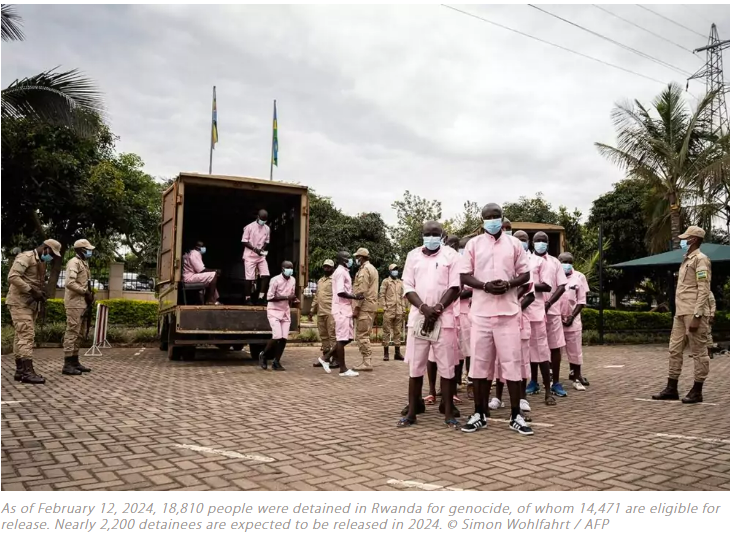
Muhanga Correctional Facility in Rwanda houses a staggering 737 “génocidaires” – inmates convicted of crimes during the 1994 Rwandan genocide against the Tutsi. Of these, 728 have been sentenced, with 71 receiving life imprisonment sentences.
The numbers across Rwanda’s prisons are even more striking. As of February 2024, out of 87,621 total inmates, 18,810 (21.4%) are imprisoned for genocide crimes, including 6.3% women. Of the génocidaires, 4,339 (23.06%), with 1.7% women, have life sentences. This leaves 14,471 eligible for release after serving their terms.
Remarkably, the Rwanda Correctional Service estimates that around 2,200 of these genocide convicts will be released across the country in 2024 alone. This continues a trend of releases – in 2012 there were 39,572 people convicted or awaiting trial for genocide crimes.
The génocidaires come from all walks of life – prefects, mayors, military, teachers, clergy, journalists and the poor. Only one member of the interim government during the genocide, Agnès Ntamabyariro, has been convicted in Rwanda, receiving life imprisonment in 2009. Another 15 ministers were tried by the International Criminal Tribunal.
At Muhanga, out of 7,346 total inmates, the 737 génocidaires live alongside ordinary prisoners with no discrimination. One inmate, 67-year-old Emmanuel Ruzigana, a former mayor who gave genocidal orders, calls his 30-year sentence “light compared to the crime of genocide.” After decades, he believes most génocidaires have been humbled by the consequences of their horrific actions. Ends
***
By Emmanuel Sehene Ruvugiro, JusticeInfo.net Special Envoy to Muhanga Correctional Facility, Rwanda (Originally published in long form on Justiceinfo.net on April 02/2024).
However, a recent experience in a Twitter Space (a feature for live audio group discussions) revealed to me that what seems commonly understood about the genocide is, in fact, not so universally acknowledged. As with the Holocaust, despite extensive scholarship and survivor testimonies, the genocide against the Tutsis continues to face denial and lack of understanding. During this discussion, I was abruptly removed for merely mentioning the term “genocide against the Tutsis” – a phrase that the participants vehemently contested.
Their main argument was against the specific phrase “genocide against the Tutsi,” noting that Hutus were also victims during the same period. While it’s true that some moderate Hutus – including those who opposed the Habyarimana regime, those intermarried with Tutsis, and even Hutus mistaken for Tutsis due to facial stereotypes – were killed, this doesn’t alter the characterization of the event as a genocide against the Tutsi.
The term “genocide against the Tutsi” doesn’t negate the fact that others, including foreigners, were killed; it simply clarifies the primary intent of the perpetrators: to exterminate the Tutsi as an ethnic group.
This distinction is crucial. The Tutsis were targeted for extermination based on their ethnic identity, which aligns with the 1948 UN Genocide Convention’s definition. The Convention defines genocide as acts committed with intent to destroy, in whole or in part, a national, ethnic, racial, or religious group. This specificity is what differentiates genocide from other crimes.
The moderate Hutus and others were targeted for their actions (such as marrying or protecting Tutsis or opposing the Hutu Power faction) and their political views. Examples include Boniface Ngurinzira, the Foreign Affairs Minister from the moderate MDR party, and Agathe Uwiringiyimana, the Prime Minister, both of whom were murdered not for being Hutus, but for their political opposition to the Habyarimana regime and the subsequent genocidal government.
These killings, while heinous, fall under different categories of international law, such as crimes against humanity or war crimes, but not under genocide as defined by the 1948 Convention on the Punishment and Prevention of the Crime of Genocide. This exclusion of political opinion from the genocide definition was a point of contention among scholars and human rights activists during the drafting of the Convention. Yet, it was not included in the final version.
Some extremists call the appellation genocide against the Tutsi RPF propaganda but it is not. Survivors have fought to have a clear definition of the extermination of Tutsis since 1994 when the new RPF government employed vague phrases like ‘’itsembatsemba n’itsembabwoko –loosely translated as massacres and genocide. It took more than 10 years of advocacy for the RPF Government to start using the term genocide against the Tutsi as survivors have initially demanded.
While the term ‘’genocide against the Tutsi’’ is a good starting point, I hope better terms attempting to show the extent of this tragedy that annihilated 9 out 10 Tutsis in Rwanda, can be coined. My preference is something like Irimburabatutsi (Annihilation of Tutsi).
In Rwanda, possessing an ID card labeled “Tutsi” was effectively a death sentence, whereas “Hutu” indicated a chance for survival. Moderate Hutus could sometimes find safety in unfamiliar areas, but for Tutsis, there was no safe haven in Rwanda during the genocide.
This stark reality highlights the specific targeting of the Tutsi and underscores why the term “genocide against the Tutsi” is not only accurate but essential for historical and legal clarity. Surprisingly, this understanding is not as widespread as one might expect, underscoring the need for continued education and awareness about the true nature of the Rwandan Genocide.
The Kinyarwanda proverb “amaraso arasama,” meaning “shedding blood curses the doer,” came to mind recently as I reflected on the uncertain fate of Rwandan genocide convicts who remain detained despite serving their sentences.
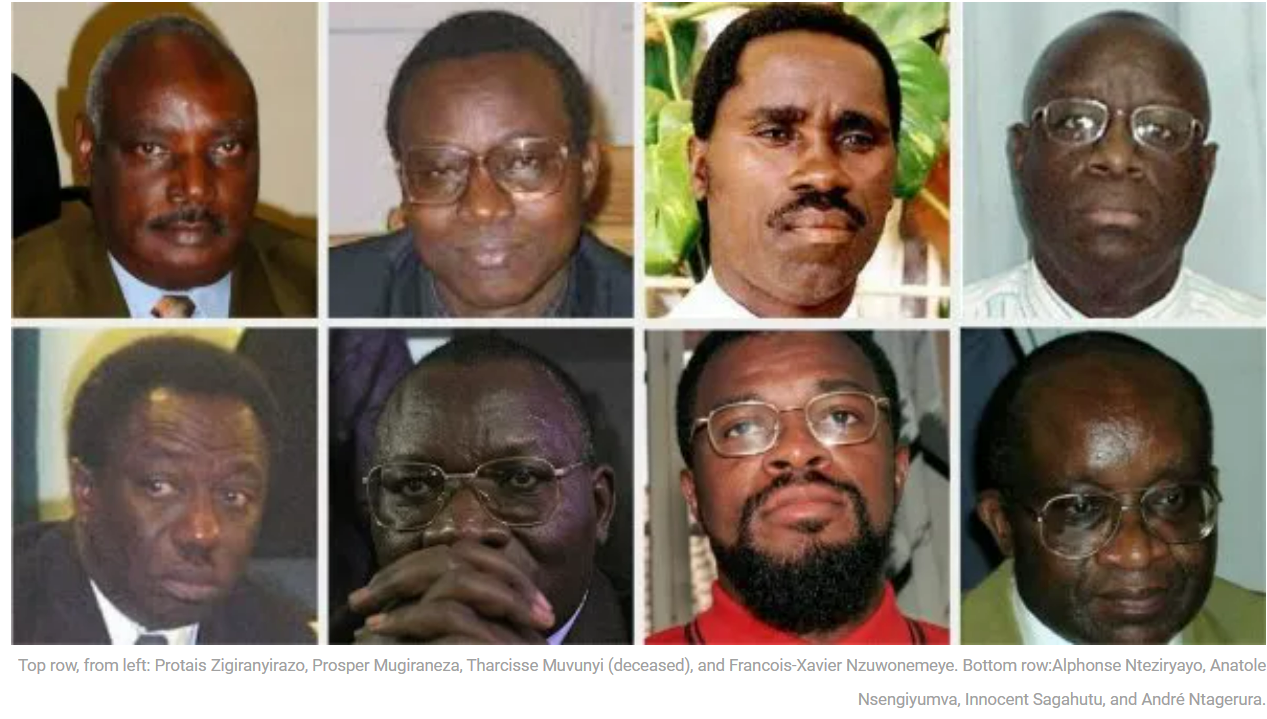
According to a recent report, seven former officials implicated in the 1994 genocide currently face extended limbo in Niger after their request for transfer was denied. These detainees include former military and political officials who were tried for their role in the 1994 genocide, either acquitted or released after serving their sentences at the International Criminal Tribunal for Rwanda (ICTR).
Names like Major François-Xavier Nzuwonemeye, Prosper Mugiraneza, Protais Zigiranyirazo, Andre Ntagerura, Alphonse Nteziryayo, Anatole Nsengiyumva, Tharcisse Muvunyi (now deceased), and Innocent Sagahutu instantly evoke memories of the fear, violence, and death during the 100 horrific days.
As the most powerful figures directing the massacres, rapes, torture, and devastation of Tutsis in Rwanda, we were left to face the machete, countless Hutu killers, the roadblocks, and the fear they orchestrated to exterminate Tutsis.
In 1994, the world abandoned us to the slaughter at their hands. Today, although no machete hangs over their heads, the world seems to shut its doors, leaving them in isolation and uncertainty.
Is this karma? As a survivor, it’s tempting to think so. But principles of justice shouldn’t be defined by vengeance. Their prolonged detention raises complex questions of human rights and international law.
As a lawyer, I wrestle with the issues surrounding their situation. But as a survivor, objectivity is infinitely harder. This predicament embodies the intricacies of justice after genocide. They now find themselves tangled in technicalities, diplomacy, and public opinion.
While their plight is real, we cannot forget its roots lie in crimes against humanity. They plead for second chances and asylum, but survivors and the global community still grapple with their pasts. Can justice be served while upholding human rights? The answers elude me.
I believe compassion and hope must prevail over hatred and division. But we must never forget and repeat past mistakes.
My heart holds pain for the memories, and hope for the future. While the past can’t be undone, our actions today shape tomorrow. The fate of these genocide convicts is about more than just themselves but; it’s about global values and humanity.
Their names still evoke dread, but hope compels me to wish better for our shared humanity.
“Amaraso arasama” reminds us to question blind hate, lest more blood be shed. Like Prosper Mugiraneza and Edouard Karemera, once decent men who tragically embraced the unexamined Hutu Power ideology labeling Tutsis as enemies, we are all vulnerable without moral courage.
For those who knew these men before the genocide, they attest Mugiraneza and Karemera and a few more big fishes, were once reasonable men but fell prey to the toxic ideology that fanned the flames of violence. Let their fate be a lesson to Rwanda, Africa and the world. Ends
Genocide Fugitive, Claude Muhayimana/Photo/The New Times
Former hotel driver goes on trial in Paris on Monday, accused of complicity in Rwanda’s 1994 genocide by transporting Hutu militiamen who massacred hundreds of Tutsis.
Claude Muhayimana, whom investigators say also hid Tutsis at risk of death and helped some escape, fled after the genocide and gained French nationality in 2010. He faces a life sentence if convincted.
The genocide, one of the worst atrocities of the 20th century, saw 800,000 minority Tutsis and moderate members of the Hutu majority slaughtered in just three months, in massacres orchestrated and inflamed by the authorities.
Around 50 witnesses are expected testify at what will be the third trial of Rwandan genocide suspects in France, whose legal system grants universal jurisdiction to judges prosecuting crimes against humanity.
Three people have already been convicted: an army officer sentenced to 25 years in prison, and two mayors who were given life sentences.
But Muhayimana will be the first “ordinary” citizen to face justice having been considered “respectable all around” before the killings, said Alexandre Kiabski, a lawyer for the Collective of Civil Parties for Rwanda (CPCR), one of the plaintiffs.
He dismissed claims by the defence that Muhayimana had no choice but to obey the Hutu authorities, saying “there were other drivers who refused.”
The trial is expected to last a month, and the dozens of witnesses include 15 from Rwanda. Covid-19 travel restrictions prompted judges to postpone the trial earlier this year.
Muhayimana was arrested in France in 2014 after an investigation by Paris prosecutors specialised in crimes against humanity that was prompted by a victims’ association.
He spent a year in preventive detention before being released on probation, when he resumed his work as a road repair agent in the northern French city of Rouen.
Now aged 60, he is accused of knowingly driving Hutu police and militiamen called the Interahamwe to carry out massacres in the western Kibuye region.
Tens of thousands of Tutsis were murdered as they sought shelter in schools, churches and hotels.
The executioners then turned their focus to neighbouring areas, with witnesses saying they left each morning amid shouts of “exterminate them!”
Muhayimana, who was married to a Tutsi woman at the time, has denied the charges, saying he was not in Kibuye when the massacres took place.
– ‘Waiting 10 years’ –
Investigators also discovered that he had hidden Tutsis at risk of death and helped some flee.
“He is going to fully explain himself,” his lawyer Philippe Meilhac told AFP. “This is a man who has been waiting 10 years for this.”
France has generally refused requests to extradite suspects to Rwanda, prompting President Paul Kagame to accuse Paris of denying Rwanda jurisdiction.
But relations between the two countries have warmed considerably since a historians’ report commissioned by President Emmanuel Macron and released in March, recognised France’s “overwhelming” responsibilities in failing to halt the massacres.
That was followed by a visit by Macron to Kigali in May, when he acknowledged that his country had ignored warnings of the impending massacres while backing the genocidal regime.
“If this trial can contribute to the need for memory and pay homage to the victims, that’s already a lot,” said Nima Haeri, a lawyer for one of the civil plaintiffs.
Around 30 trials of other Rwanda genocide suspects remain to be heard by French courts
US Department of Justice Press Release: A Rwanda native, most recently residing in Buffalo, New York, has been denaturalized by consent and departed from the United States under an order of removal following the filing of a complaint citing his suspected involvement in the Rwandan genocide in 1994.
According to court documents, Peter Kalimu, aka Pierre Kalimu, aka Fidele Twizere, was living in Rwanda in 1994, when the genocide Against the Tutsi erupted. During the genocide, members of the majority Hutu population persecuted the minority Tutsis, committing mass murder and looting their property, among other crimes. An estimated 800,000 ethnic Tutsis and moderate Hutus were killed during the three-month genocide. The complaint against Kalimu alleged that he participated in two attacks on Tutsi families in his neighborhood during the genocide, and that he looted property from Tutsi families whose houses he then destroyed. Kalimu denied these allegations.
According to the civil denaturalization complaint, while living in Rwanda, Kalimu went by the name Fidèle Twizere. After he left Rwanda, he used a different name – Pierre Kalimu – and provided only that name, and a new date of birth, on his U.S. immigration forms. Throughout the process of applying for permanent residence and U.S. citizenship, Kalimu never disclosed to the U.S. government his previous identity as Fidèle Twizere or his prior use of a different date of birth. The complaint further alleged that Kalimu’s misrepresentations about his identity precluded U.S. government officials from investigating him and determining that he was not qualified to obtain immigration and naturalization benefits.
Kalimu admitted that he was ineligible for citizenship because he engaged in welfare fraud in New York in 2003-2004 – one of the allegations in the civil denaturalization complaint – and agreed to denaturalization. The Justice Department obtained an order from the U.S. District Court for the Western District of New York, effective Sept. 1, revoking Kalimu’s naturalized U.S. citizenship by consent, and the court entered judgment in favor of the United States on Sept. 30.
In a separate prosecution, in 2018, Kalimu pleaded guilty to and was convicted of, one felony count of making materially false statements about his true name to federal investigators of the Department of Homeland Security (DHS).
On Oct. 12, a U.S. Immigration Judge in Buffalo, ordered Kalimu’s removal for making materially false statements to procure immigration and naturalization benefits. Kalimu agreed to the entry of the order against him. On Oct. 21, Kalimu departed the United States.
“In seeking to escape his past in Rwanda, Kalimu obscured his true identity and repeatedly lied to immigration officers in order to become a U.S. citizen,” said Assistant Attorney General Kenneth A. Polite Jr. of the justice Department’s Criminal Division.
“The United States will not be a safe haven for suspected human rights violators,” said Acting Assistant Attorney General Brian M. Boynton of the Justice Department’s Civil Division. “The Justice Department is dedicated to preventing those who commit human rights violations from evading our immigration laws.”
“Kalimu’s misrepresentations to the U.S. government paved the way for the defendant to avoid discovery of his past transgressions and to establish a life in the United States, which included benefits afforded to all citizens,” stated U.S. Attorney Trini E. Ross of the Western District of New York. “Because of the diligent work of the various government agencies involved with this investigation to uncover the truth and make amends for the lies and omissions of the defendant, he was rightly prosecuted, was removed from our country, and can no longer escape his actual past.”
“HSI special agents will not cease in our pursuit of identifying and bringing to justice those individuals who have participated in unthinkable war crimes and human rights abuses,” said Executive Associate Director Steve Francis of Homeland Security Investigations (HSI). “In coordination with the HSI-led Human Rights Violators and War Crimes Center in Washington, D.C., our special agents and prosecutors continue to ensure that perpetrators are held accountable and denied safe haven in the United States.”
This matter was litigated by the Department of Justice Criminal Division’s Human Rights and Special Prosecutions Section (HRSP) and the Civil Division’s Office of Immigration Litigation (OIL) Enforcement Section; and the U.S. Attorney’s Office for the Western District of New York.
U.S. Immigration and Customs Enforcement’s (ICE) HSI Buffalo and HSI’s Human Rights Violators and War Crimes Unit investigated this matter. Valuable consultation and support were provided by ICE’s Office of the Principal Legal Advisor (OPLA) Human Rights Law Division and the Buffalo Office of the Principal Legal Advisor.
The civil denaturalization case was prosecuted by Senior Counsel Steven Platt of OIL; Assistant U.S. Attorney Daniel Moar for the Western District of New York; Trial Attorney Susan Masling, and Director of Human Rights Enforcement Strategy and Policy Eli Rosenbaum of HRSP, supported by HRSP Chief Historian Dr. Jeffrey Richter. The removal case was litigated by ICE’s Buffalo Office of the Principal Legal Advisor.
Members of the public who have information about foreign nationals or naturalized U.S. citizens suspected of engaging in human rights abuses or war crimes are encouraged to call the ICE tip line at 1-866-DHS-2-ICE or to complete its online tip form.
Carine and her son Jean-Pierre, one of the thousands born as a result of rape during the genocide
A 24-year-old Rwandan whose mother was raped in the genocide tells the BBC how he came to learn of the circumstances of his birth. “My son kept asking who his father was. But among 100 men or more who raped me, I could not tell the father.” Click here to read this moving story as it appeared on the BBC today.
…It is not easy for those involved to recall the events – even a quarter of a century later. Hearing Carine’s story, it is clear why she waited until her son was old enough to hear the truth.
She was about the same age as him the first time she was raped, one of the hundreds of thousands mainly Tutsi women and girls believed to have been sexually assaulted by Hutu neighbors, militia and soldiers.
The genocide had just begun, and she was still bleeding from two machete wounds on either side of her face – wounds which still make it hard to eat and speak today.
Her assailants – people who had once been part of the same community – had dragged her to the edge of a pit where they were dumping the bodies of the men, women, and children they had just systematically murdered in a school.
But despite her wounds, despite the pain, Carine knew she did not want to die. She also knew she did not want to die when a group of soldiers sexually assaulted her with small trees and sticks just hours later, causing unimaginable damage.
It was only when another group attacked her, biting her all over her body, she decided she no longer wanted to live.
“Now I wanted to die soon. I wanted to die so many times.”
But her ordeal had only just begun: the hospital which tried to save her life was quickly overrun by Hutu militia.
“I couldn’t run away.
I couldn’t go because everything was broken,” she says.
“Whoever wanted to have sex with me could. If the perpetrators wanted to urinate, they could come and do it on me.”
It was only when the hospital was liberated by the rebel Rwandan Patriotic Front that Carine finally got the treatment she needed, and was allowed to return home to her village – weak, broken, bleeding, but alive…
So when the doctors discovered she was pregnant, they were shocked…
L-R, My wife and my mother -in- law slightly before she was murdered in the 1994 Genocide against the Tutsi in Rwanda.
For every survivor of genocide, there is at least one day that irreversibly shatters their life—a day so harrowing that its full gravity can only be understood by those who endured it. For my wife, Shiki, her brothers, our dear friend Frida, and many others, that day is May 7. It is the day they lost their loved ones.
Most people outside Rwanda may be unfamiliar with the full story of the 1994 genocide.
In April of that year, Rwanda’s majority ethnic group—the Hutu, who made up about 84% of the country’s seven million people—together with their Hutu supremacist government, launched a coordinated plan to exterminate the Tutsi, a minority comprising roughly 14% of the population. Their goal was to wipe out every Tutsi in the country. Over the course of 100 days, more than one million Tutsi—around 85% of the Tutsi population within Rwanda—were systematically slaughtered.
On May 7, 1994, my wife narrowly escaped death when Hutu killers attacked her home in Kagarama, a neighborhood in Rwanda’s capital, Kigali. Her mother was not so fortunate. Armed with rifles, the killers fired indiscriminately at everyone in the house and left them lying in front of their home, presumed dead. The haunting image of her mother’s lifeless body on the ground—surrounded by her wounded children—is a memory my wife cannot forget. She was only seven years old at the time, and she still relives the terror of that day. Covered in blood and severely injured, she and her brother, Aristarque, got up and started walking into the unknown. How they survived is a story for another day.
The call to wipe out Tutsi lives resonated in every corner of Rwanda—from Kigali to distant districts like Nyanza in the south. There was no place where the blood of Tutsi was not shed. Our close friend Frida, who was in Nyanza at the time, shares this same dark date with my wife. She witnessed her entire family being brutally butchered with machetes; she herself was buried alive in a pit with her relatives. Frida alone survived. Her story of courage and resilience is covered in a memoir she re-published in 2017.
The brutality my wife experienced at the hands of Hutus on that Saturday of May in 1994, left deep visible and even deeper invisible scars in her life.
Today, visible scars are healing. She got used to doing everything with one hand. She successfully learned how to write again using a different hand. She drives a car. She is even faster than me at typing.
My wife, Shiki, and I, April 2018.
It is impossible, though, for her to forget that she once had a normal life before the dark date of May 7. Impossible to forget that she was once able to tie her hair or peel vegetables without any help. Impossible to forget this dark day that robbed all her childhood’s innocence.
The invisible wounds, however, will apparently stay with genocide survivors as long as they live. Nightmares and flashbacks of the terrible images my wife and many other survivors witnessed haunt them on a regular basis.
‘’This makes me sometimes wonder if surviving in itself is a good thing or NOT. It is difficult to live with such a heavy burden of memory on my weak shoulders.” My wife, Shiki, told me recently.
The dark day of May 7, 1994, robbed me a chance to ever see a hero that gave life to my wife. My children will never afford the luxury of having a grandmother. The Hutus took her life so soon, so young.
Although I never met her before, I see her every day through her beautiful daughter that I married. We talk about her all the time. Her love, her courage and above all, her resilience against all odds.
She endured what no one should experience in life.
She raised her four children as a single mom and found a modest job, teaching in primary school during the day and at the same time, working as a private tutor in the evening to make some extra money.
May 7th took an iron woman from us. May her soul rest in peace, and may the souls of Frida’s family and all those who perished on this day 25 years ago also rest in peace. They live on because we survived to remember them.